
Bison Tactical Blog, Competitions
Loading for PRS- Efficient but Effective

Jul
Loading for PRS or field style matches is very different from other shooting disciplines. Unlike other shooting disciplines, the size of your group downrange does not matter. The only thing the matters is if the bullet impacts the steel. The round count in a PRS match also tends to be much higher. We will often shoot 120 rounds or more at a match, while other disciplines may only shot 70. This higher round count forces forces us to find a way to load efficiently, but still produce ammo that can hit targets. Granted, this ammo doesn’t have to be as precise as that used in a Benchrest match, but if you go to a match with a gun that shoots 5 MOA, you are going to have a rough day.
Steps
The core steps of reloading are decapping and resizing, priming, throwing powder, and seating the bullet. The steps can be broken into two parts: brass prep and loading. The brass prep is everything that you do to get the cases ready for powder and a bullet. Below are the steps listed in order with an explanation of how I do them.
Brass prep
Sizing

Until recently, resizing was often deemed as unimportant and overlooked. Now we know how important sizing really is. In field shooting, we full length resize our cases, which moves the shoulder of the brass. The shoulder is the angled part where the case body tapers into the neck. Each time you fire a round, the shoulder gets blown out and conforms to the inside of the chamber. If you were to try to reinsert a fired piece of brass, you would feel a lot of resistance closing the bolt. That is because the case has fireformed to the chamber. To avoid a difficult bolt close, I resize both the body, shoulder, and neck of the case. This way I have room for the case to slide in, and I don’t have to worry hard bolt close. Benchrest shooters will often neck only size their brass, because it is believed to yield more accurate ammunition. Even if this were true, if would be a terrible idea to neck size for PRS shooting. Because the shoulder has no room in the chamber, it is much more likely to cause issues. When I resize my brass, I always bump the shoulder back 2 or 3 thousandths. That gives me enough room in my chamber, but it doesn’t shorten the life of the brass.
Overworking your brass causes it to become brittle and makes it prone to case head separations, and other issues. These are not only nightmares to run into at matches, but it costs money. When you are shooting quality brass like Lapua or Alpha, it costs about $1.25 per piece. When you are paying that much it is important to get your money’s worth. I am running some of my Dasher cases well over 15 firings. I haven’t had a case head separation yet, but my I’ve tossed over 50 cases because of loose primer pockets. To find your shoulder bump, you’ll need a headspace gauge. A variety of manufacturers make them. Forester makes a great gauge kit that included a gauge for both the shoulder bump and for base to ogive measurements.
Before you begin sizing, it is important to lube your cases. I’ve tried many lubes, but Imperial Die Wax and Alpha Spray Lube are my favorites. When you are on the press, do not try to run through the cases as fast as possible. I have learned this the hard way. After having a few too many hard bolt closes at matches, I implemented a dwell time at the bottom of the press stroke so I know that I am getting the proper sizing every time. This means that when I reach the bottom of the press stroke, I hold it there for a second or two. Since I’ve implemented this, I haven’t run into hard bolt closes.
I choose to decap my cases while I am resizing. Some shooters opt to use a dedicated decapping die instead of decapping when they are sizing. The benefit of this is that you get to punch the primer out, tumble them, and then size them. With this method, you never run dirty cases through the sizing die. Another approach is tumbling the cases first, without decapping. This way you run clean cases through the dies without the added step. With both of these methods, you do not get clean loaded rounds. After sizing, there is residual lube on the case which doesn’t get cleaned off. I opt to just size and decap at once, as my first step. That way I get clean primer pockets, save time, and get the lube off of the cases. I have used this method for years, and I have not had any issues with my dies.
Neck Expansion
With a standard sizing die the case neck is undersized on the down stroke, then an expanded ball opens the neck up to the proper diameter on the upstroke. Many argue that this can lead to inconsistent neck tension on the bullet, which leads to larger velocity spreads and higher SDs. They say that using an expander mandrel is a better way to size the neck because it leads to more consistent tension on the bullet. I don’t bother with an expander mandrel because I can still achieve SDs below 5 with a standard sizing process. If I used an expander mandrel the SD’s may get smaller, but what would the benefit be? An SD of 5 is plenty and will not cost you any points.
Cleaning
Cleaning is important for many reasons. The most important of which is to remove all of the lube from the cases. It also help get rid of all of the fouling on the neck and sometimes the shoulder. Lots of the time our brass gets stomped into the dirt when shooting PRS, and I believe it’s better to get all of that stuff out of your brass and not have to worry about foreign material in loaded rounds. There are many ways to clean brass, but I’ve always been happy with vibratory tumbling. It is much easier than wet tumbling, it gets my brass as clean as I need it, I can tumble hundreds of cases at once. I tumble with cheap rice bought in bulk, and often mixed with wheat. When I tumble with wheat, I do a 3:1 ratio of rice to wheat. The wheat acts as an abrasive, and the rice absorbs the carbon. After a thousand or two cases have been tumbled, the rice turns a repulsive gray color, which is when I toss it. I’ve never had good luck tumbling with walnut media, it always seems to leave a dusty residue. It is important to note that rice can sometimes get stuck in primer pockets, so I’ve made a habit of checking them. If I find any, I punch it out with a toothpick.
Trimming and Chamfer
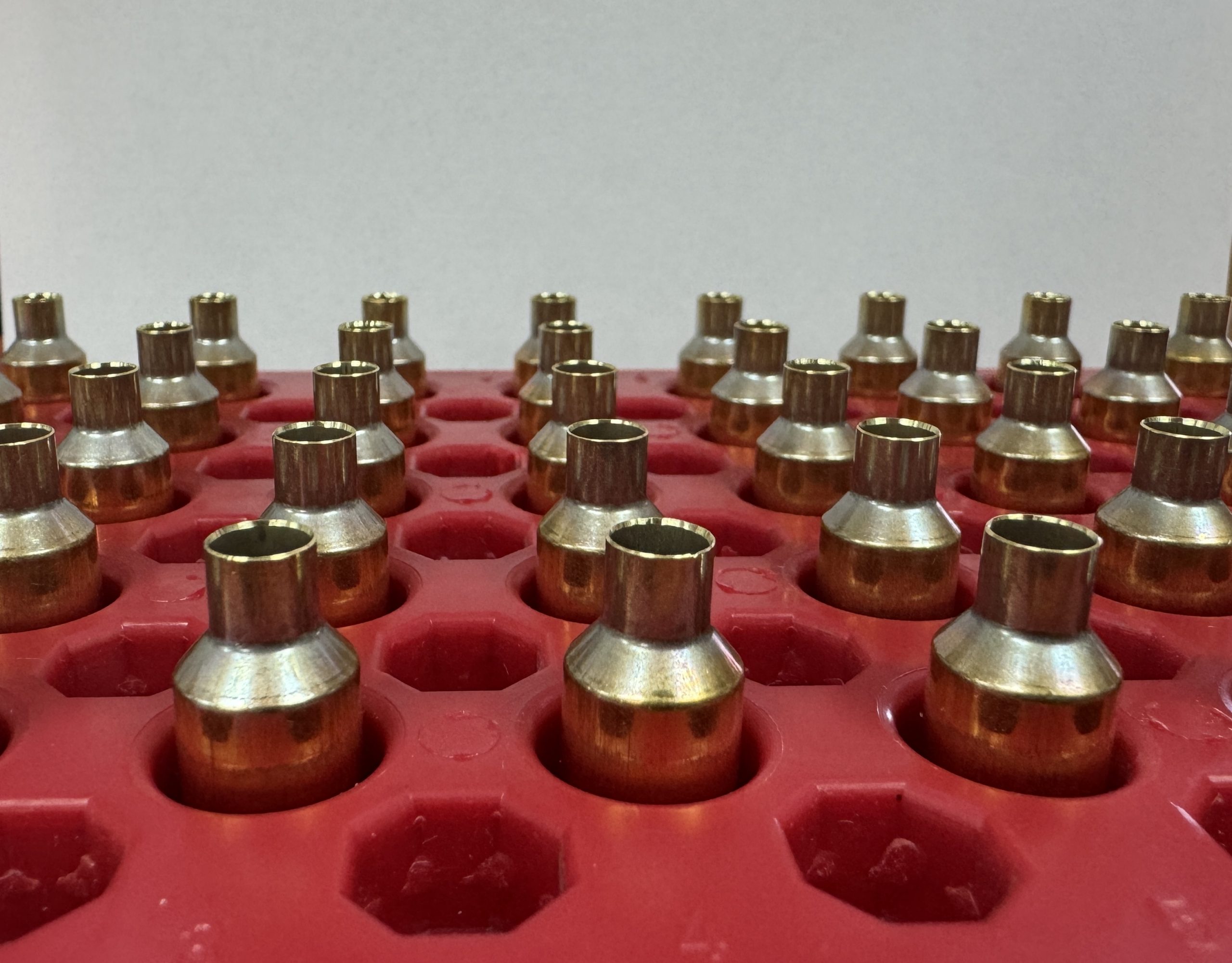
This step is vital to smooth bullet seating and keeping the jacket intact, but it is also arguably the worst step in the process. I used the Giraud trimmer, which preps the brass in under 5 seconds. The Giraud is easily the most valuable piece of kit a reloader can have. It makes prepping thousands of pieces of brass a breeze. If you are shooting a modern cartridge like most of those used for PRS, your neck likely does not flow much, so you shouldn’t have to trim again for the life of the brass. I trim before the first loading and then never touch it again. The bevel on the case mouth stays intact for the life of the brass as well, so there is no reason to put a new chamfer on it.
Priming
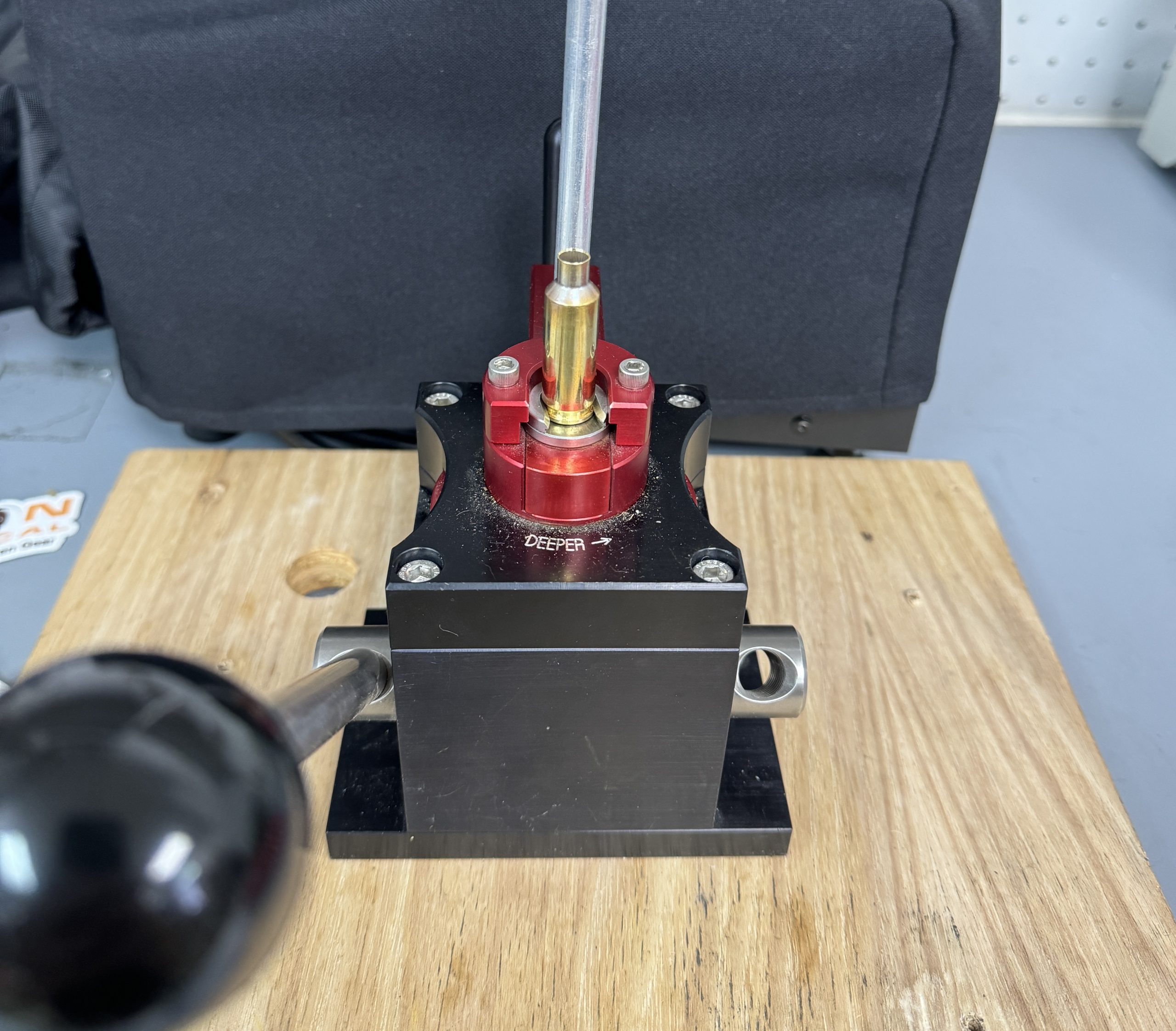
Many people say that your priming process has a big impact on your load’s performance, but I do not. I primed on a RCBS hand primer for the longest time, and when I started using the Primal Rights Competition Primer Seater, I saw no difference. I defiantly felt one though. Those hand primers work great, but that can start to hurt when you are priming in large batches.
Loading
Powder
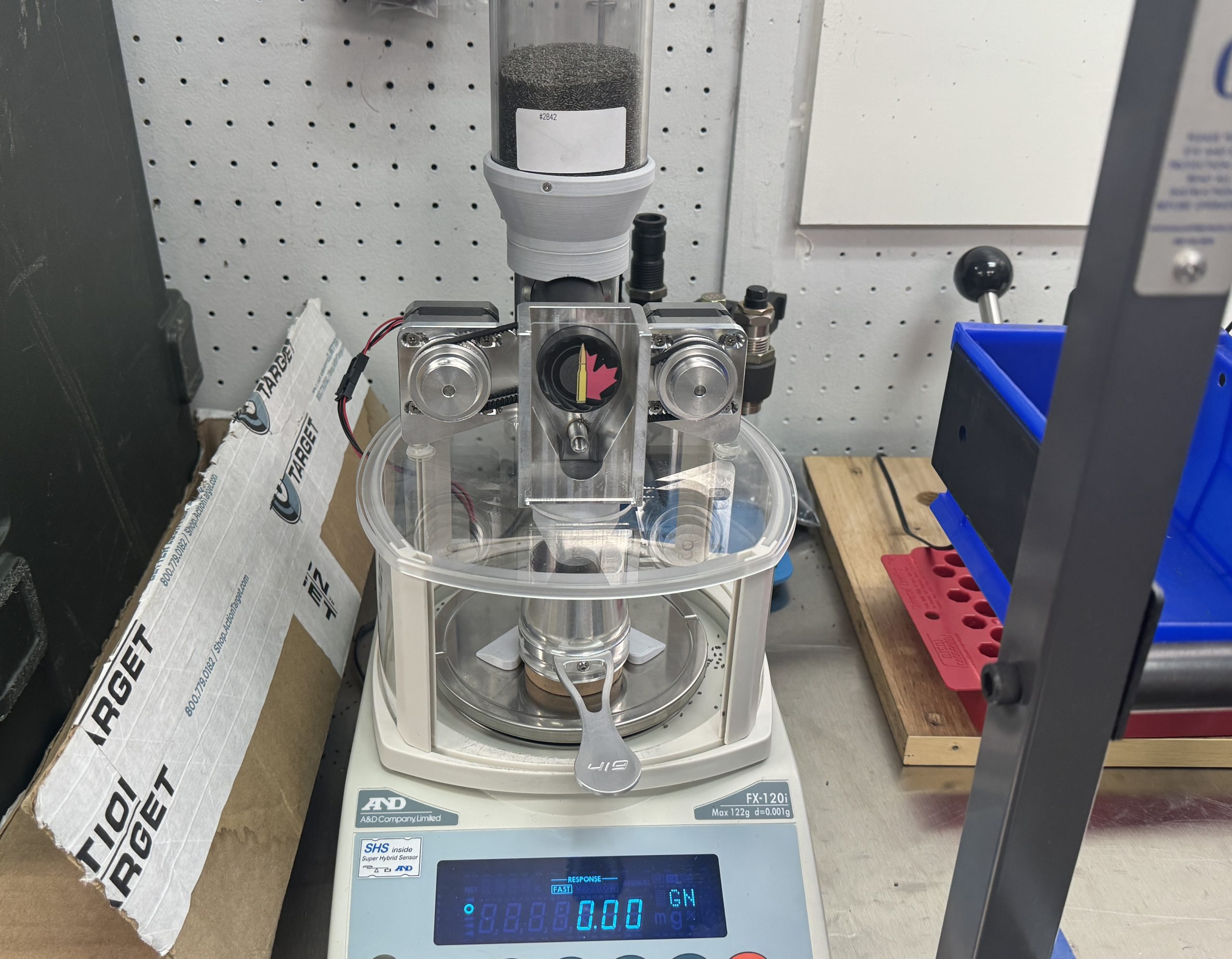
A consistent powder charge is important for a consistent load. Powder charge directly contributes to velocity, so if your powder charge is inconsistent then your velocity will be too. I handle the powder charge with much more precision than other steps of my process for that reason. I expect my powder charge to be plus or minus 0.02 grains of my target charge. I use the Autotrickler to throw powder. It has all the precision I need, and it is fast enough. I have also thrown charges with a Promethus Gen 2 powder scale, but despite its higher price point I saw no improvement in my velocity deviations.
It is very important to have a robust system so you don’t double charge a case, or even worse, miss a case. Not dropping powder in a case often results in the bullet getting propelled into the barrel from the blast of the primer, then getting stuck partway through. If you have a squib and don’t catch it, it will likely result in an explosion.
Seating Bullets

There really isn’t much to seating bullets. All the work was in the brass prep, so now you get to relax and watch as your mountain of ammo piles up. I seat with Forster micrometer die, and a Co-Ax press which gives me great, concentric ammo. You’ll be able to tell if the chamfer on your neck and if your tension is correct by the amount of pressure it takes to seat. If you somehow missed the chamfer on a case, it will take much more effort to seat the bullet.
Why so simple?
Overall, my process is pretty simple. I am able to get away with such a simple, easy loading process for two main reasons. For one, I use great components. I use quality Sierra Bullets, good brass like Alpha or Lapua, and good barrels chambered by good gunsmiths. I also have a very rigorous load development process. This process allows me to be efficient and cut out unnecessary, time consuming things. Click here top learn how to find a load for PRS shooting. Using this process, I am able to consistently achieve 15 round groups under 3/4″ at 100 yards. That is more than enough for the kind of shooting that we do. You will almost never find a target under 1 MOA at a PRS match, so there isn’t much point in chasing tiny groups. With that being said, a 15 round group under 0.75 inches is very respectable.